
Word List
Ending Sounds
An ending sound is the last sound you hear in a word: cat ends with /t/ and sun ends with /n/. Children usually hear it after the first sound and before the middle one, by late kindergarten or early first grade. Below are the ending sounds with picture words, free picture sorts and missing-letter worksheets, and how to practise at home.
An ending sound is a sound, not a letter. Say cat slowly and the last thing you hear is /t/. Say lamb and the last thing you hear is /m/, even though the last letter is b. Your child is listening, not reading, which is why a child who cannot read yet can do it with pictures.
Some ending sounds can be held and some stop. You can hold /m/ and /n/ at the end of a word, “sunnnn”, so they are easy to hear. /t/, /p/, /g/, /b/ and /d/ stop the moment you say them, and a child often misses them. Start with the sounds you can hold.
When do children learn ending sounds?
Children hear the first sound in a word, then the last, then the middle. The phonemic awareness assessment published by Reading Rockets asks the three in that order. It gives the age each is typically mastered: the first sound by the middle of kindergarten, and the last and middle sounds by late kindergarten or early first grade. The Common Core kindergarten standard RF.K.2d asks children to “isolate and pronounce the initial, medial vowel, and final sounds” in three-sound words like cat. It leaves out words that end in /l/, /r/, or /x/, and none of the words on this page do.
A preschooler can name a picture and tell you its last sound out loud. A kindergartner can then match that sound to a letter. If the first sound is still new, start with beginning sounds. The middle sound is the short vowel, which short vowel sounds covers.
The ending sounds list
These are the seven ending sounds on this page’s worksheets, three picture words each. Tap a sound or a word to hear it.
| Sound | Held or stops? | Picture words |
|---|---|---|
| /m/ | Held | drum, jam, lamb |
| /n/ | Held | sun, fan, hen |
| /t/ | Stops | cat, hat, pot |
| /p/ | Stops | cap, map, mop |
| /g/ | Stops | pig, dog, egg |
| /b/ | Stops | crab, tub, web |
| /d/ | Stops | bed, sled, bread |
How do you teach beginning and ending sounds together?
Once your child knows first sounds, ask two questions about the same picture: “What does cat start with? What does it end with?” Two questions on one picture is how a child starts to hear every sound in a word, which is the step before sounding words out. The beginning sounds worksheets cover the first question.
Words that end in m, t, g and b
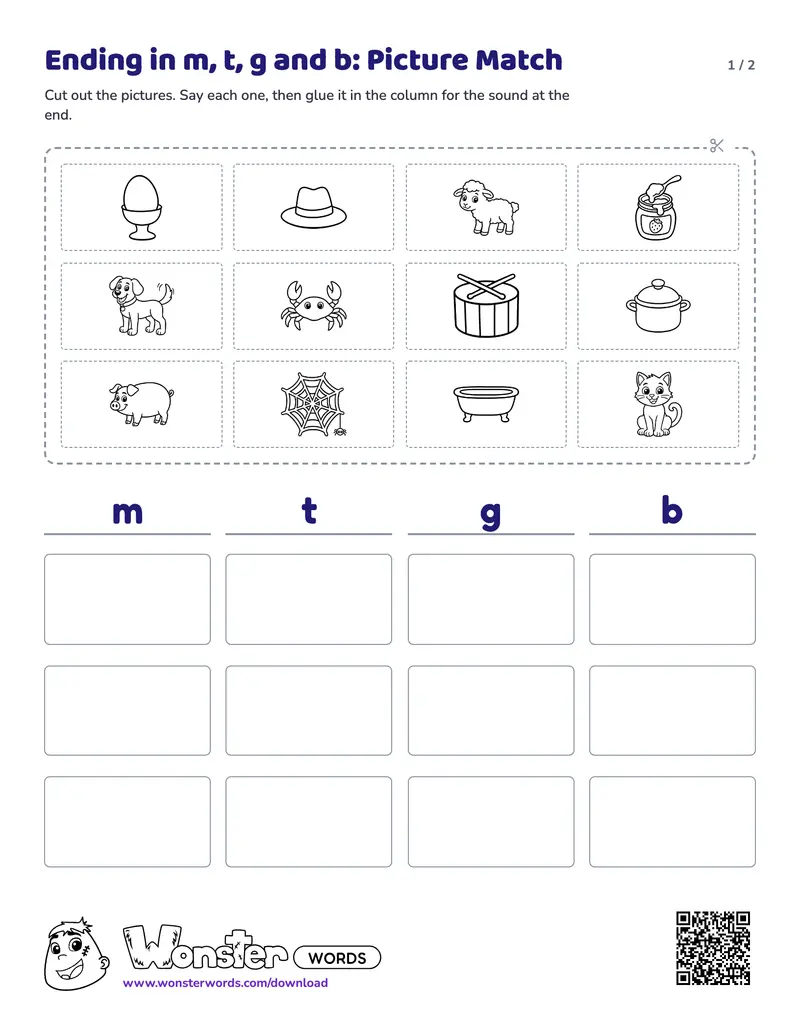
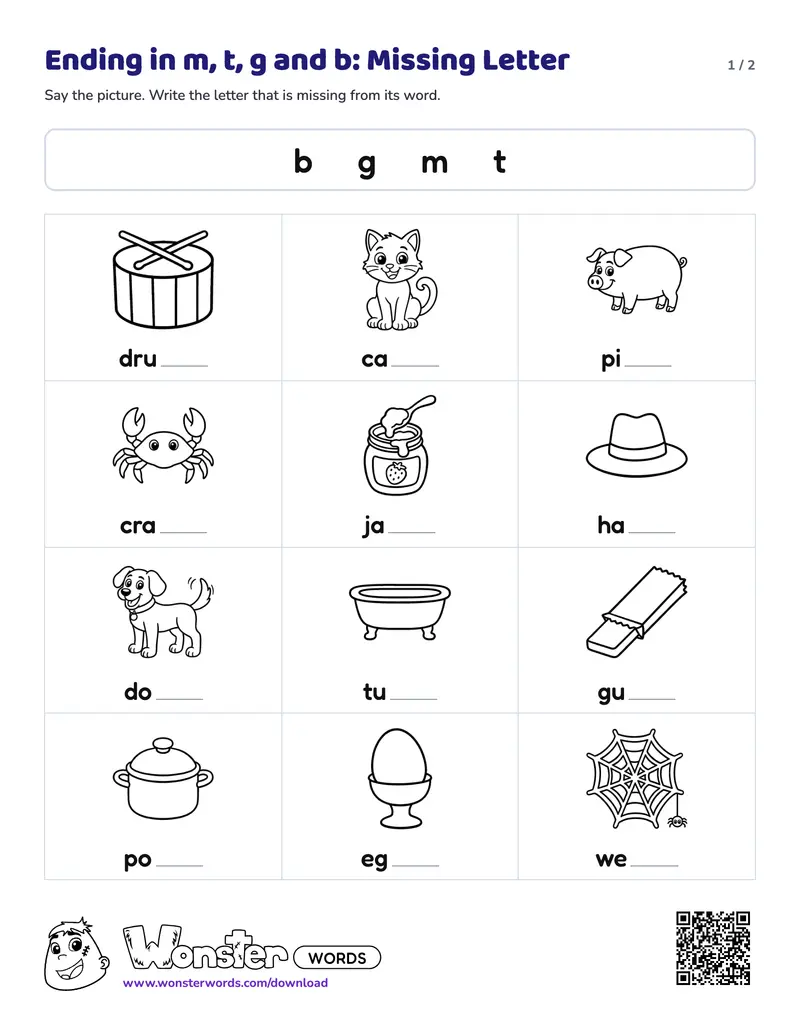
Of the ending sounds m, t, g and b, only /m/ can be held. /t/, /g/ and /b/ stop. Say each picture’s name slowly and lean on the last sound. For a sound that stops, say it a little louder rather than adding a vowel: “ca-t”, not “ca-tuh”.
- Ends in /m/: drum, jam, lamb
- Ends in /t/: cat, hat, pot
- Ends in /g/: pig, dog, egg
- Ends in /b/: crab, tub, web
A preschooler names the picture and says its last sound, then glues it under the letter you point to. A kindergartner can read the letter at the top of each column and fill in the missing last letter on the second sheet.
- drum
- jam
- lamb
- gum
- cat
- hat
- pot
- pig
- dog
- egg
- crab
- tub
- web
Free PDF · no sign-up
Printables for Ending in m, t, g and b
Words that end in n, p and d
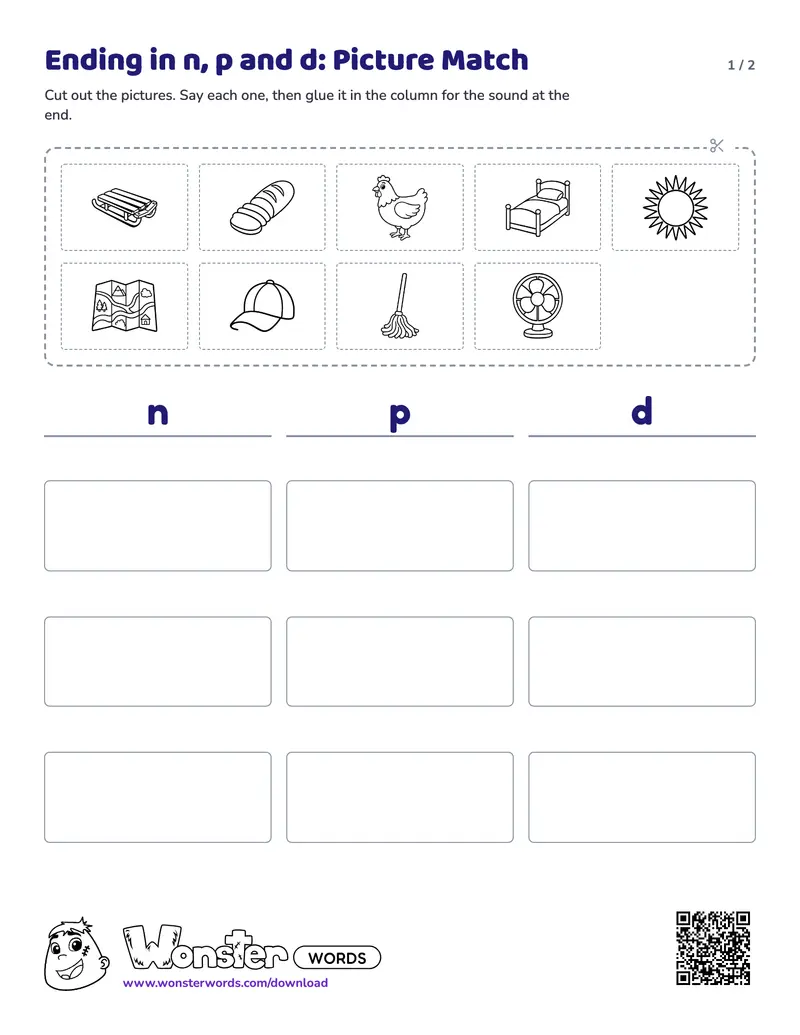
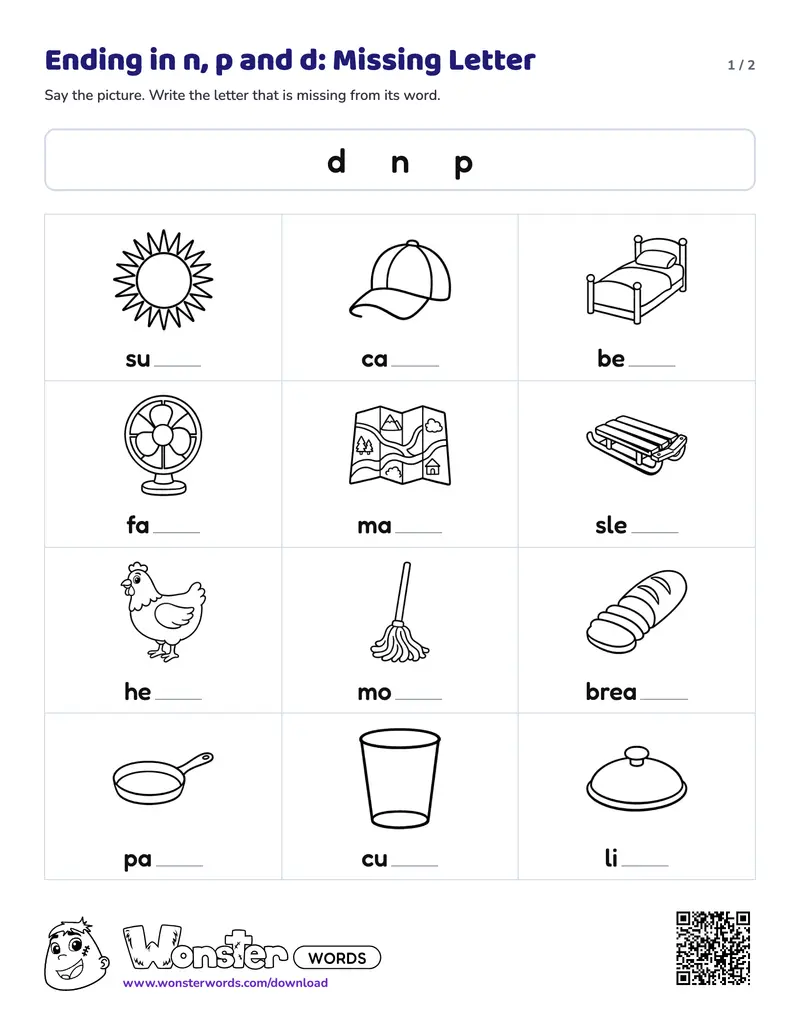
/n/ can be held at the end of a word, and /p/ and /d/ stop. /p/ and /b/ are made the same way and differ only in the voice, so they go on different sheets. The same goes for /d/ and /t/, and for /n/ and /m/.
- sun
- fan
- hen
- cap
- map
- mop
- bed
- sled
- bread
- pan
- cup
- lid
Free PDF · no sign-up
Printables for Ending in n, p and d
- Ending in n, p and d: Picture Match (PDF)9 pictures · answer key included · 2 pages
Preview page 1Preview
How do you teach ending sounds at home?
Teach ending sounds out loud first, a few minutes at a time, with words your child already says. No paper is needed until the sounds come easily.
- Say the word slowly, then ask for the last sound only. “Sunnnn. What sound is at the end?” Ask for the last sound, not the last letter.
- Start with the sounds you can hold, /m/ and /n/, then move to the ones that stop.
- Then add the letter. Point to the letter that makes the sound, which is what the sheets above ask.
Three games use the same idea:
- I spy with an ending sound. “I spy something that ends with /t/.” A hat, a cat, a pot.
- Sort the toys. Put a few toys on the floor and sort them by their last sound.
- Pairs. Cut out the pictures from a sort and find two that end the same way.
Words with the same ending sound are not always rhymes. Cat and net end the same way and do not rhyme, because a rhyme shares the vowel too. If your child is still working on rhymes, how to teach rhyming covers it, and the two help each other.
Your child has it when they can tell you the last sound of a new picture word without you stretching it out. The next steps are the middle sound, which is the short vowel, and then reading whole CVC words. Hearing the sounds in words has more spoken games for every stage.
If it is not clicking yet at 4, that is expected: most children have it by late kindergarten or early first grade. Stay with the sounds you can hold for a few weeks before adding the others. A child who leaves the last sound off when they talk, saying “ca” for cat, is a different question, about speech rather than listening, and final consonant deletion explains it.
Frequently asked questions
What are ending sounds in phonics and why are they important?
An ending sound is the last sound you hear in a word, like the /t/ at the end of cat. Hearing it is part of hearing every sound in a word, which is what a child needs to sound out a word and to spell one.
Should beginning or ending sounds be taught first? Pros and cons?
Beginning sounds first. The first sound is the easiest to hear, and most children have it by the middle of kindergarten. The last sound comes next, by late kindergarten or early first grade, and the middle sound around the same time or just after.
What age group benefits the most from CVC ending sounds worksheets?
Preschoolers can sort pictures by their last sound once they can name the pictures, with no letters at all. Kindergartners add the letter, which is when a missing-letter sheet makes sense. Most children hear the last sound by late kindergarten or early first grade.
Can I use rhymes to help sort words with the same ending sound?
Yes, as a starting point. Rhyming words share the vowel and the end, like cat and hat. Words with the same ending sound only share the last sound, like cat and net. A child who hears rhymes can narrow down to the last sound from there.
Related lists