
Math
Addition With Regrouping, Step by Step
Addition with regrouping, which many parents learned as carrying, for two- and three-digit numbers: the steps, the order to practice in, the common mistakes, and free worksheets with answer keys.
Grades: grade 1 to grade 3 · Common Core: 1.NBT.C.4, 2.NBT.B.5, 2.NBT.B.6, 2.NBT.B.7, 3.NBT.A.2 · Texas: 2.4(B), 3.4(A) · Related: Common Core 2.NBT.B.9; Texas 1.3(A), 2.4(C)
Addition with regrouping is adding in columns when a column makes 10 or more, so that 10 of one place are traded for 1 of the next. It is what many parents learned as carrying. In 46 + 37, the ones make 13: the 3 stays under the ones, the 1 ten joins the tens, and 4 + 3 + 1 = 8 tens, so the answer is 83.
Children start making a new ten in first grade, and second graders add with regrouping within 100 and then within 1,000. Our guide to what regrouping means explains why schools no longer say carrying, and the other direction, subtracting with regrouping, has its own guide. A free addition with regrouping worksheet, with answer keys, is at the end of this guide.
Addition with regrouping, step by step
Addition with regrouping means adding one place at a time, starting with the ones, and moving a new ten into the next column whenever a column makes 10 or more. These are the five steps on 46 + 37:
Line up the places
Write the numbers in columns, ones under ones and tens under tens. In 46 + 37, the 6 sits over the 7 and the 4 over the 3.
Add the ones
Start with the ones column, on the right: 6 + 7 = 13.
Regroup if the ones make 10 or more
Thirteen ones are 1 ten and 3 ones. Write the 3 under the ones, and write the 1 ten in the tens column, above it or small on the line. Regroup at exactly 10 too: 10 ones are 1 ten and 0 ones.
Add the tens, with the regrouped ten
Add the tens column and the regrouped ten together: 4 + 3 + 1 = 8 tens.
Read the answer and check it
The answer is 8 tens and 3 ones, which is 83. Check it with an estimate: 46 + 37 is a little more than 40 + 40, so an answer near 80 is right.
With three-digit numbers the steps run across three columns, and one sum can regroup twice. The Common Core Standards Writing Team uses 278 + 147 as its example in the progressions document for base ten:
- Ones: 8 + 7 = 15. Write the 5 and regroup 1 ten.
- Tens: 7 + 4 + 1 = 12 tens. Write the 2 and regroup 1 hundred.
- Hundreds: 2 + 1 + 1 = 4 hundreds.
The sum is 425. In the tens column, 12 tens are 120, so the 1 that moves this time is a hundred.
Above the column or on the line: where the regrouped 1 goes
The regrouped 1 can be written above the next column or small on the line under it, and both are right. Most parents learned to write it above. The progressions document draws it on the line, under the numbers being added, which leaves those numbers as they were. The 15 is then written “1 then 5” rather than “write the 5 and carry the 1”. Eureka Math calls the 1 on the line “new groups below” in its second-grade Module 4. The same module notes that some children arrive “already having learned addition in vertical form, including carrying above the tens”, and connects that method to blocks and drawings rather than replacing it. Follow your child’s class sheet.
Start without regrouping, then two-digit, then three-digit
Practice addition in columns in four stages: no regrouping first, then two-digit sums that sometimes need it, then sums past 100, then three-digit numbers. An addition needs regrouping when a column adds up to 10 or more. The sum 43 + 55 never does, and 47 + 23 does, because 7 + 3 makes exactly 10.
- No regrouping, such as 43 + 55 = 98, so that lining up the columns becomes a habit before anything moves between them.
- Two-digit sums within 100, mixed, where some problems regroup the ones and some do not, such as 47 + 23 beside 53 + 23.
- Sums past 100, where the tens regroup into a hundred, as in 68 + 45 = 113, and adding three or four two-digit numbers, which is second-grade standard 2.NBT.B.6.
- Three-digit numbers, with one regroup and then two, as in 278 + 147.
Mix problems that need regrouping with problems that do not. A child who regroups on every problem has learned a routine, not a decision. The progressions document suggests including subtraction problems “requiring two, one, and no decompositions”, and the same reasoning holds for addition. The free worksheet on this page follows these four stages, and every page after the first mixes the two kinds.
Common addition with regrouping mistakes and how to fix them
Nearly every mistake in addition with regrouping treats the digits as separate numbers instead of tens and ones, and each one shows in the wrong answer.
- Writing 713 for 46 + 37: all of the 13 under the ones. The ones make 13 and the child writes all of it under the ones, then 7 for the tens. Ask: “Thirteen is one ten and three ones. Which part stays in this column?”
- Writing 73 for 46 + 37: the ten regrouped, then dropped. The 3 is right, but the tens column never got its extra ten. Have your child write the 1 before adding the tens.
- Writing 710 for 45 + 35: no regroup at exactly 10. The ones make 10 and the child writes “10” in the ones place. Ten ones are a ten, so the ones get a 0 and the tens get the 1, for 80.
- Writing 127 for 47 + 8: the columns lined up from the left. The 8 was written under the 4, so it was added as 80. Line up ones under ones, from the right, and use the light lines between the places on the first six pages of the worksheet.
- Writing 108 for 43 + 55: a regroup where none is needed. The child writes a 1 over the tens out of habit. Before each problem, ask whether the ones make 10 or more; the mixed pages of the worksheet ask that question on every row.
- Writing 325 for 278 + 147: the second regroup lost. The tens make 12, and the 1 hundred never reaches the hundreds column. Say each regroup out loud: “Twelve tens are 1 hundred and 2 tens.”
When the same mistake keeps coming back, go back to blocks or a drawing for the same problem, then to the columns. Check that the basic facts are quick, since a child counting 6 + 7 on fingers has little attention left for the regroup. Math facts explains how fact fluency is built, and making ten is the same move as a regroup, inside one column. If regrouping is still hard at the end of second grade, talk to your child’s teacher. The subtraction mistakes, such as 43 for 82 − 45, are on the subtraction with regrouping page.
How to help your child with regrouping at home, and games to play
Help with regrouping at home in short sessions, with real objects before drawings and drawings before numbers alone. The What Works Clearinghouse guide Assisting Students Struggling with Mathematics (2021) is written for intervention teachers. It rates using objects and drawings, connected explicitly to the written numbers and faded only once a child is accurate, as having strong evidence, from 28 studies. These five habits adapt that advice for home:
- Keep it to 10 minutes and a few problems. Stop while it is still going well.
- Say it in place value. “Thirteen ones are 1 ten and 3 ones” tells your child what the 1 is, and “carry the 1” does not.
- Build one problem. Bundle 10 straws with a rubber band to make a ten, or cut out the paper blocks from the base ten blocks guide. Do the night’s first problem with them.
- Estimate first. The sum 46 + 37 is about 80, so an answer of 713 cannot be right, and your child can catch it alone.
- Ask for one explanation a night. Second-grade standard 2.NBT.B.9 asks children to “explain why addition and subtraction strategies work”, and the explanation shows you whether your child understands the regroup or is following a routine.
Three games practice regrouping with dice or playing cards:
- Race to 100. Roll two dice and take that many ones (straws, beans, or cubes). Whenever you have 10 ones, trade them for a ten. The first player to 10 tens wins.
- Make the biggest sum. Deal four cards from ace (1) to 9 and arrange them as two two-digit numbers with the biggest sum you can. Add them in columns, and say whether you regrouped.
- Regroup or not? Write addition problems on cards. Flip one, and before anyone works it out, each player says “regroup” or “no regroup”. A right call scores a point.
Board games with two dice practice adding too, and math board games explains which ones. The subtraction with regrouping games, such as race to zero, run the trade the other way.
Free addition with regrouping worksheets
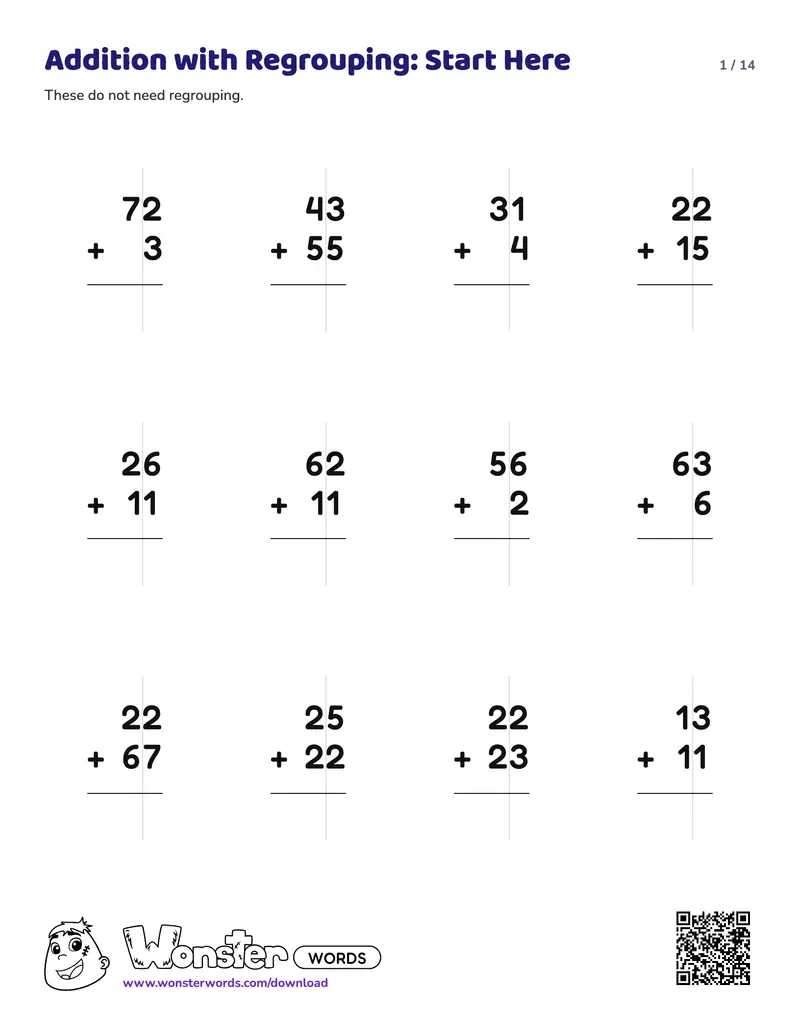
Our free addition with regrouping worksheet is one PDF of 14 pages: five activities, each printed twice, then three answer key pages and a page for grown-ups. Each activity’s second page has the same problems in a new order.
- Pages 1–2, Start Here: 12 two-digit problems a page that need no regrouping, such as 43 + 55. For a child who has not regrouped yet.
- Pages 3–4, Regroup the Ones: sums within 100, where 8 of the 12 problems regroup the ones and 4 do not, including 47 + 23, whose ones make exactly 10. From late first grade, and in second grade.
- Pages 5–6, Sums Past 100: 12 problems a page, 9 that regroup the ones, the tens, or both, such as 94 + 28 = 122, and 3 that need none, with a last row adding three or four two-digit numbers. For second grade.
- Pages 7–8, Three-Digit, One Regroup: 9 problems a page, 6 regrouping once in the ones or the tens and 3 needing none. For late second grade and third grade.
- Pages 9–10, Three-Digit, Two Regroups: 9 problems a page, 6 regrouping at least twice and 3 needing none. They include 278 + 147, and 635 + 365 = 1,000, which regroups in every column.
Every problem has room for the regrouped 1 above the next column or on the line. The first six pages add light lines between the places. The answer key shows every page in miniature, with each sum in red where your child writes it and each regrouped 1 in red above its column. A 1 your child writes on the line instead is right too. The last page tells a grown-up what the sheet practices and how to use it. It prints in black and white, with no account and no email.
For a child who needs the picture first, the Base Ten Blocks: Regrouping sheet draws each trade in blocks. For two-digit practice with no regrouping at all, use the worksheets within 100. The subtraction worksheet, across zeros included, is on the borrowing page.
Free PDF · no sign-up
Free printable addition with regrouping worksheets
One free PDF of 14 pages that prints in black and white, with no account and no email: no regrouping first, then the ones, sums past 100, and three-digit sums. Each activity prints twice, with three answer key pages and a last page for grown-ups.
- Addition with Regrouping (PDF)108 problems · answer key included · 14 pages
Preview page 1Preview
Frequently asked questions
How can I explain addition with regrouping in simple terms?
Tell your child that 10 ones make 1 ten, so a column that adds up to 10 or more passes a ten to the next column. In 46 + 37, the ones make 13, which is 1 ten and 3 ones. The 3 stays in the ones, and the ten joins the tens, where 4 + 3 + 1 = 8 tens. The answer is 83.
How do you know when to regroup in addition?
Regroup whenever a column adds up to 10 or more, including exactly 10. In 47 + 23, the ones make 7 + 3 = 10, which is 1 ten and 0 ones, so write the 0 and regroup the ten. In 43 + 55, the ones make 8 and the tens make 9, so nothing is regrouped. Check each column on its own, starting with the ones.
What grade do kids typically learn addition with regrouping?
Children start in first grade, when adding a two-digit and a one-digit number sometimes makes a new ten. Second graders add with regrouping within 100, add up to four two-digit numbers, and then add within 1,000 with models or drawings. Third graders add within 1,000 fluently, and fourth graders use the column method by its name, the standard algorithm.
What common mistakes do kids make when learning addition with regrouping?
Nearly every mistake treats the digits as separate numbers instead of tens and ones. In 46 + 37, a child who writes all of the 13 under the ones gets 713, and one who drops the regrouped ten gets 73. Other common slips are writing 10 in the ones place, as in 710 for 45 + 35, lining the columns up from the left, and regrouping when no column makes 10.
How can parents help their kids with addition with regrouping at home?
Keep each session to about 10 minutes and a few problems, and say each step in place value: 13 ones are 1 ten and 3 ones. Build the first problem with bundled straws or paper blocks, estimate before adding, and ask for one explanation a night. Games with dice or cards, such as race to 100, practice the trade too.
Related guides
Last updated