
Math
Doubles, Near Doubles, and Make Ten
The addition strategies kids learn before memorizing facts: what each one is, which facts it solves, what grade it belongs to, and how to teach it at home, with free worksheets.
Grades: kindergarten to grade 2 · Common Core: 1.OA.C.6, 1.OA.B.3, 2.OA.B.2 · Texas: 1.3(C), 1.3(D), 1.3(E), 2.4(A) · Related: Common Core K.OA.A.4, K.OA.A.5, K.NBT.A.1, 1.OA.C.5, 1.OA.A.2, 1.OA.D.8, 2.OA.C.3; Texas 1.2(B), 1.5(G), 2.7(A)
Doubles, near doubles, and making ten are three ways children work out an addition fact instead of counting. A double adds a number to itself: 6 + 6 = 12. A near double leans on the double next to it, so 6 + 7 is 6 + 6 and 1 more, 13. Making ten fills a ten first, so 8 + 5 is 8 + 2 + 3, and 10 + 3 = 13. Doubles and near doubles work only when the two numbers are equal or close, while making ten works for any fact that goes past 10.
The most useful move at home is to say the double first: “6 and 6 is 12, so 6 and 7 is 13.” Children begin to remember doubles in late kindergarten, first grade teaches all three strategies, and second graders are expected to know these facts from memory. Free worksheets for each strategy, with answer keys, are at the end of this guide.
What are doubles facts?
A doubles fact is an addition fact that adds a number to itself, such as 4 + 4 = 8 or 9 + 9 = 18. There are ten of them from 1 + 1 to 10 + 10, and every answer is an even number, because a double is two equal groups. Doubles are among the first facts children remember. Children vary in which sums they recall first, but doubles, adding one, and small totals are “the most readily recalled”, according to the National Research Council’s review of the research, Adding It Up. A double is one number said twice, and many doubles have a picture a child can see and count at home.
| Double | Where a child can see it |
|---|---|
| 1 + 1 = 2 | A pair of shoes |
| 2 + 2 = 4 | Two pairs of socks |
| 3 + 3 = 6 | A domino with 3 dots on each half |
| 4 + 4 = 8 | A domino with 4 dots on each half |
| 5 + 5 = 10 | Two hands |
| 6 + 6 = 12 | A dozen egg carton, 6 in each row |
| 7 + 7 = 14 | Two rows of dots, each a 5 and 2 more |
| 8 + 8 = 16 | Two rows of dots, each a 5 and 3 more |
| 9 + 9 = 18 | Two rows of dots, each a 5 and 4 more |
| 10 + 10 = 20 | Fingers and toes |
Neither the Common Core nor the Texas standards (TEKS) use the word “doubles”. Second-grade standard 2.OA.C.3 comes closest: it asks children to write an even number “as a sum of two equal addends”, and two equal addends are a double.
What are near doubles (doubles plus one)?
A near double is an addition fact whose two numbers are 1 or 2 apart, and a child solves it from the double beside it: 6 + 7 = 6 + 6 + 1 = 13. When the numbers are 1 apart, as in 6 + 7, it is also called a doubles plus one fact. The step 6 + 6 + 1 is the Common Core’s own example in first-grade standard 1.OA.C.6, which calls the move “creating equivalent but easier or known sums”. A child can think it two ways: double the smaller number and add 1, or double the larger and take 1 away (6 + 7 = 7 + 7 − 1 = 13). The order does not matter, so 7 + 6 uses the same double as 6 + 7.
Facts whose numbers are 2 apart are doubles plus two. For 6 + 8, double the 6 and add 2 (12 + 2 = 14), or use the double in the middle, 7 + 7 = 14. The middle double gives the same total because the 8 gives 1 to the 6. A fact such as 5 + 6 = 11 uses the double 5 + 5 = 10, and 7 + 8 uses 7 + 7 = 14, so 7 + 8 = 15.
What is the make ten strategy?
The make ten strategy (also called making ten or make a ten) splits one number to fill the other up to 10, then adds what is left. For 8 + 5, the 8 needs 2 more to make 10, so split the 5 into 2 and 3: 8 + 2 = 10, and 10 + 3 = 13. The Common Core writes it as 8 + 6 = 8 + 2 + 4 = 10 + 4 = 14 in standard 1.OA.C.6. It works for any fact that goes past 10, such as 9 + 4, 8 + 6, and 7 + 5.
The Common Core Standards Writing Team lists three things a child needs before making ten, in its progressions document for operations:
- The partner that makes 10 for any number, such as 8 and 2 (kindergarten standard K.OA.A.4).
- All the ways to split a number below 10, such as 5 as 2 and 3.
- The teen numbers as 10 and some more, such as 13 as 10 and 3.
The same document notes that making ten is “more difficult in English” than in East Asian languages, which say the teens as “ten one, ten two”. In English, “fourteen” says the 4 first, while the numeral 14 puts the ten first.
With three numbers, look for two that make 10 and add them first. In 7 + 4 + 3, add the 7 and the 3 to make 10, then 10 + 4 = 14. Standard 1.OA.B.3’s own example is 2 + 6 + 4 = 2 + 10 = 12. Adding in any order is one of the properties of addition.
Making ten for subtraction: take from ten
Making ten works for subtraction too, in two ways, and both go through 10.
- Back through ten. For 13 − 4, take away 3 to reach 10, then 1 more: 13 − 3 − 1 = 10 − 1 = 9. This is the Common Core’s own example in 1.OA.C.6.
- Take from ten. For 13 − 5, split 13 into 10 and 3. Take the 5 from the 10, which leaves 5, then add back the 3 ones: 5 + 3 = 8.
Take from ten suits taking away a big number, such as 9, 8, or 7. Back through ten suits taking away a number only a little bigger than the ones, such as 4 from 13. The name “take from ten” is the one Eureka Math uses. Its first-grade Module 2 calls the two strategies “make ten or take from ten”, and it starts by taking 9 from the teen numbers, then 8. The Take From Ten worksheet practices those two, mixed on each page.
The same splits can be drawn on several models. A child can make ten on two ten frames, as a number bond, as a jump to 10 on a number line, or by sliding beads on a rekenrek.
Doubles, near doubles, or make ten: which strategy for which fact?
Doubles, near doubles, and making ten each suit a different kind of fact, so the fact decides which one to use. This table covers every addition fact within 20:
| When the fact looks like | Use | Example |
|---|---|---|
| Adding 1, 2, or 3 | Counting on | 8 + 2: “nine, ten” |
| The same number twice | A double | 7 + 7 = 14 |
| Two numbers 1 or 2 apart | A near double | 7 + 8 = 7 + 7 + 1 = 15 |
| One number is 8 or 9, or the sum passes 10 | Make ten | 9 + 5 = 10 + 4 = 14 |
Some facts fit more than one row. The fact 7 + 8 is a near double and also a make ten (7 + 3 + 5 = 10 + 5 = 15), and a child uses whichever comes more easily. Texas asks first graders to “explain strategies used” (1.3(E), TEKS grade 1), so choosing is part of the lesson. Counting on, the first row, is taught with the rest of the addition strategies in the order kids learn them.
Making ten is not better than doubles; it works for more facts. The Common Core Standards Writing Team says in its progressions document that a doubles plus one or plus two method “works for certain numbers”. Such methods “do not connect with place value the way make-a-ten methods do”. It calls making ten “the most important” of these methods, because it connects with the place value first graders are learning and works “for any numbers”.
The way most parents learned 8 + 5, by heart or by counting on from 8 to 13, still gives the right answer. Making ten writes one route to that answer out in steps: 8 and 2 is 10, and 3 more is 13. Grown-ups use more than one route too: “even adults have been found to use a range of different procedures for simple addition problems”, in the words of the National Research Council. New math vs. old math shows the same kind of problem solved both ways.
Why kids learn strategies before memorizing facts
Strategies are the route to memorized facts, not a replacement for them. A child who knows 6 + 6 = 12 can work out 6 + 7 instead of counting from 1 or guessing. A fact worked out the same way many times becomes a fact remembered. The Common Core Standards Writing Team sorts the methods into three levels in its progressions document: counting all, then counting on, then turning a fact into an easier one, such as a near double or a ten. Eureka Math teaches first grade in that order: counting on and then doubles and doubles plus 1 in Module 1, and making ten in Module 2.
Researchers have tested pattern-first teaching on the doubles. David Purpura and Arthur Baroody and colleagues, who count the doubles with adding 0 and 1 among “the easiest sums”, worked with first graders who were not yet quick at most of them. One group was guided to find the pattern in the doubles, and another group only practiced them. On doubles neither group had practiced, such as 8 + 8 and 9 + 9, the children taught the pattern were more fluent. The researchers suggest the difference may have come from noticing that every double is an even number. The team published the study in The Elementary School Journal in 2016.
The same standards that teach the strategies ask for memory at the end. By the end of second grade, children should “know from memory all sums of two one-digit numbers” (2.OA.B.2). Texas asks second graders to “recall basic facts to add and subtract within 20 with automaticity” (2.4(A), TEKS grade 2). Let the strategy work a fact out, then practice that fact until it is quick. Practice routines, flash cards, and timed practice are in how math fact fluency is built.
What grade do kids learn doubles and making ten?
Children meet doubles in kindergarten, learn near doubles and making ten in first grade, and are expected to know all these facts from memory by the end of second grade.
| Grade | What children do | Common Core | Texas (TEKS) |
|---|---|---|---|
| Kindergarten | Doubles to 5 + 5 on fingers and objects; the partner that makes 10; teens as 10 and some more | K.OA.A.4, K.OA.A.5, K.NBT.A.1 (related) | K.2(I) (related) |
| 1st grade | Doubles to 10 + 10, near doubles, and making ten to add and subtract within 20; explaining the strategy | 1.OA.C.6, 1.OA.B.3 | 1.3(C), 1.3(D), 1.3(E) |
| 2nd grade | All sums of two one-digit numbers from memory; even numbers as two equal addends, or by pairing objects in Texas | 2.OA.B.2; 2.OA.C.3 (related) | 2.4(A); 2.7(A) (related) |
Texas names making 10 in first grade, in standard 1.3(D): “apply basic fact strategies to add and subtract within 20, including making 10 and decomposing a number leading to a 10”. It does not name doubles. It asks children to explain the strategies they use, and to recall facts within 20 with automaticity in second grade.
The kindergarten doubles come from practice rather than a standard. Memorizing “simple facts such as doubles, adding one, and small totals” begins “in late kindergarten and first grade”, says the research summary the Everyday Mathematics writing team prepared for its fourth edition. Kindergarten standard K.OA.A.5 asks for fluency within 5, which takes in 1 + 1 and 2 + 2. In England, the early years framework expects children to recall “some number bonds to 10, including double facts” by the end of Reception, the school year for children aged 4 to 5. A kindergartner who knows that two hands make 10 is on time, and so is a first grader still counting on for 8 + 5 in the fall. The full order of strategies, from counting on to adding with regrouping, is in the addition and subtraction guide.
How to teach doubles, near doubles, and make ten at home
Teach the three strategies at home in the order Eureka Math uses, with real things before pictures and pictures before numbers. The What Works Clearinghouse guide Assisting Students Struggling with Mathematics (2021) is written for intervention teachers. It rates teaching with concrete objects and drawings as having strong evidence, and it advises fading them once children are accurate with numbers alone. These six steps adapt that order for home.
Doubles with things
Show doubles on things in the house: two hands for 5 + 5, a dozen egg carton for 6 + 6, and a domino with matching halves. Count one side, then say the double together: 6 and 6 is 12. Start with the doubles up to 5 + 5.
Doubles to 10 + 10, out loud
Say a few doubles a day, up to 10 + 10, until the answer comes without counting. With nothing to hand, draw two rows of 7 dots, each a 5 and 2 more, for 7 + 7 = 14.
Near doubles: say the double first
Build 6 + 6 with blocks, add one more block, and say it: 6 and 6 is 12, one more is 13. Then ask for 6 + 7 with no blocks, starting from the double.
Partners of ten, then make ten
Check three things first: the number that makes 10 with each number, the ways to split a number below 10, and the teens as 10 and some more. Then put 8 counters on a ten frame and 5 beside it, move 2 across to fill the frame, and read 10 and 3, which is 13.
Ask how your child worked it out
After a fact, ask how your child worked it out and let them name the strategy. Accept a different one that works: 7 + 8 can be a near double or a make ten.
Then subtraction
Run the same facts backwards. The double 6 + 6 gives 12 − 6 = 6. For 13 − 4, take away 3 to reach 10, then 1 more, which leaves 9.
Step 1 works on fingers too: a hand is 5, so two hands are 5 and 5, the way counting on fingers teaches numbers as groups. Step 4 is shown counter by counter in the ten frame routines.
Doubles and make ten games
Four games practice doubles, near doubles, and making ten with dice, cards, or things in the house, and each ends with your child saying the fact and the strategy.
- Double dice. Roll one die and double the number: a 4 is 4 + 4 = 8. Then roll two dice and ask whether the roll is a double, a near double, or neither before adding.
- Doubles hunt. Look around the house for doubles: two hands, an egg carton, a pair of shoes, and then two pairs. Your child says each one as a fact: “6 and 6 is 12.”
- Near doubles war. Use the cards from ace (1) to 10, and each player turns over one card at the same time. When the two cards are 1 apart, the first player to say the double and then the answer (“6 and 6 is 12, so 13”) takes both. Otherwise the higher card takes them.
- Make ten and more. Use only the cards from 6 to 9. Turn over two, say how many the bigger one needs to make 10, and then the answer: “9 needs 1, so 9 and 6 is 10 and 5, 15.”
For the partners of ten on their own, the number bond guide has Make ten Go Fish, and the ten frame guide has Make ten pairs and Numbers to 20. Board games with two dice roll a double about once in every six turns, and math board games explains which games practice adding.
Common mistakes with doubles, near doubles, and make ten
Most mistakes with doubles, near doubles, and making ten come from using a strategy on a fact it does not fit, or from losing track of a step. Each one has a fix you can make on the spot.
- Adjusting the wrong way. For 7 + 8, a child starts from 8 + 8 = 16 and adds 1, getting 17. Ask which double they started from and whether it is bigger or smaller than the fact: 8 + 8 is bigger, so take 1 away.
- Using a near double for numbers far apart. Solving 6 + 9 as 6 + 6 + 3 works, but holding the extra 3 is harder than making ten: 9 + 1 + 5 = 15. Keep near doubles for numbers 1 or 2 apart.
- Losing the leftover. For 8 + 5, a child makes the 10 and then writes 10 + 5 = 15, adding the whole 5 again. Cover the 2 that moved and ask what is left of the 5.
- Writing a teen backwards. A child writes 31 for thirteen, because the word says the 3 first. Say the teen as 10 and 3, and point to the 1 in 13 as the ten.
- Counting from 1 every time. A child who counts every fact from 1 does not know the doubles quickly yet. Go back to the doubles up to 5 + 5 on fingers until they come without counting.
When doubles and making ten are hard, stay on the doubles longer, and practice the partners of 10 before making ten. If counting from 1 is still the only way your child adds by the end of first grade, talk to your child’s teacher.
Going further
Doubles and making ten keep working after first grade, in three places.
- Making ten past 20. For 28 + 5, fill 30 first: 28 + 2 = 30, and 30 + 3 = 33. It is the same move done in the head, which second graders use for mental math.
- Doubling into multiplication. The doubles become the 2s facts, since 7 × 2 is 7 + 7, and doubling those gives the 4s. Multiplication facts are third-grade work: 3.OA.A.1 asks children to interpret 5 × 7 as 5 groups of 7. Texas expects third graders to “recall facts to multiply up to 10 by 10 with automaticity” (3.4(F), TEKS grade 3). Second grade lays the groundwork, adding the equal rows of an array (2.OA.C.4) and, in Texas, joining equal sets of objects in multiplication stories (2.6(A)).
- Splitting numbers before adding. In Eureka Math, kindergarten Module 4 teaches splitting numbers with the number bond model “before adding and subtracting”, which is the groundwork making ten stands on.
Free doubles, near doubles, and make ten worksheets
Our free worksheets come as four PDFs, one for each strategy, in the order a child learns them.
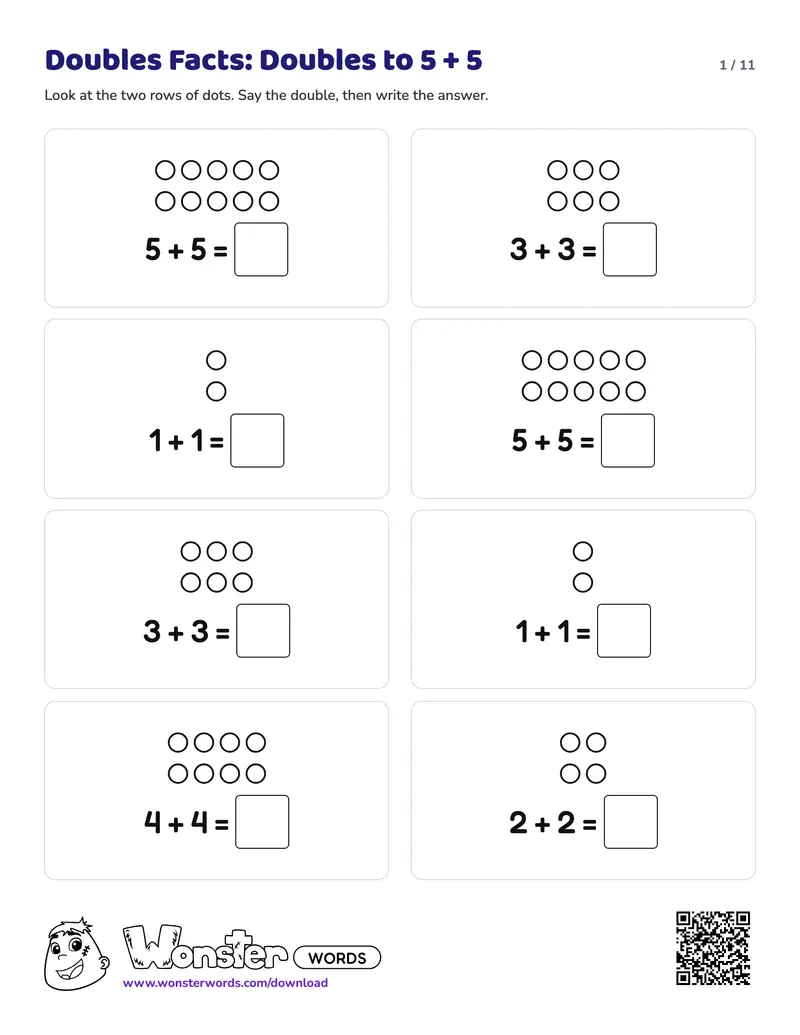
- Doubles Facts, 11 pages, from late kindergarten. Doubles to 5 + 5 drawn as two rows of dots, then the doubles from 6 + 6 to 10 + 10 with each row a five and some more, then all ten doubles in numbers, then the missing double (☐ + ☐ = 14).
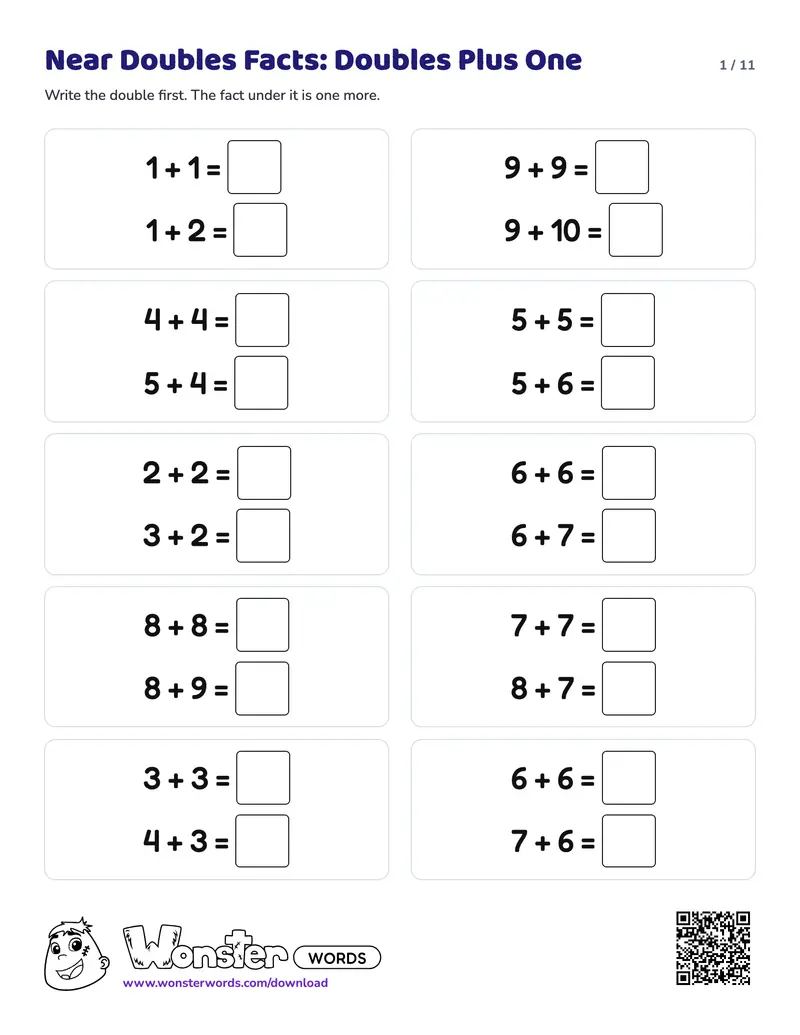
- Near Doubles Facts, 11 pages, for first grade. Doubles plus one with the double as a helper line (6 + 6 = ☐ above 6 + 7 = ☐), plus one in numbers only, doubles plus two with the middle double as the helper (7 + 7 for 6 + 8), and a page mixing both.
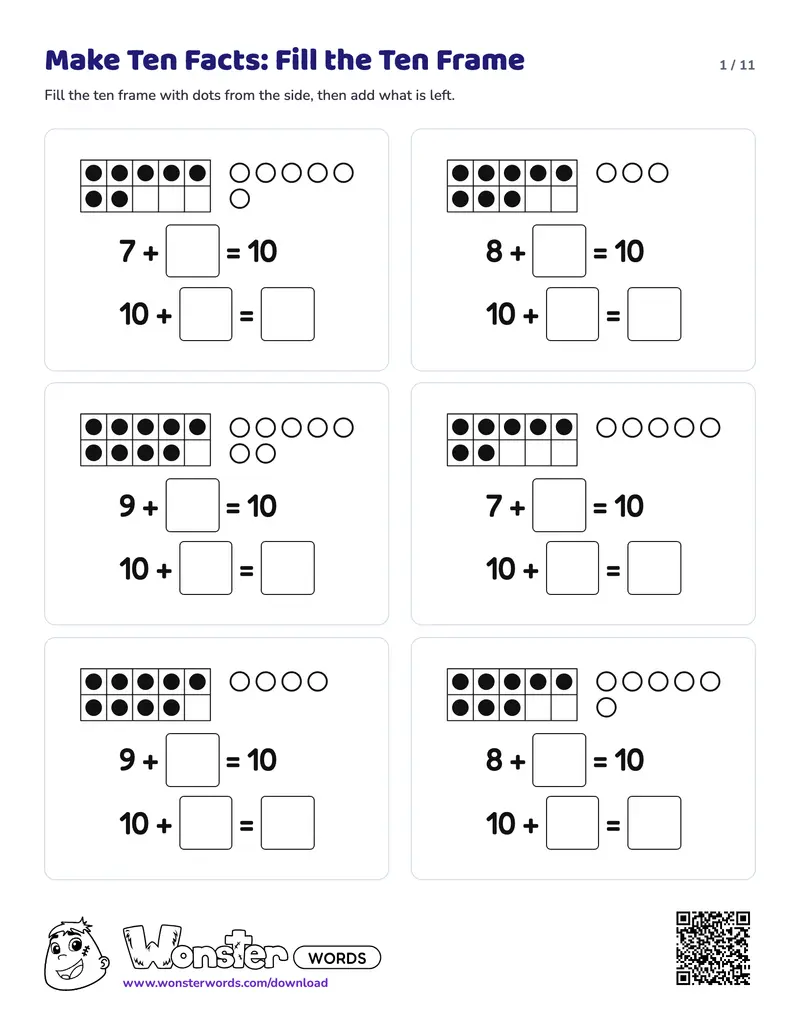
- Make Ten Facts, 11 pages, for first grade. Filling a ten frame from loose dots beside it, making ten in writing (8 + 5 = 10 + ☐ = ☐), numbers only, and three numbers where two of them make ten.
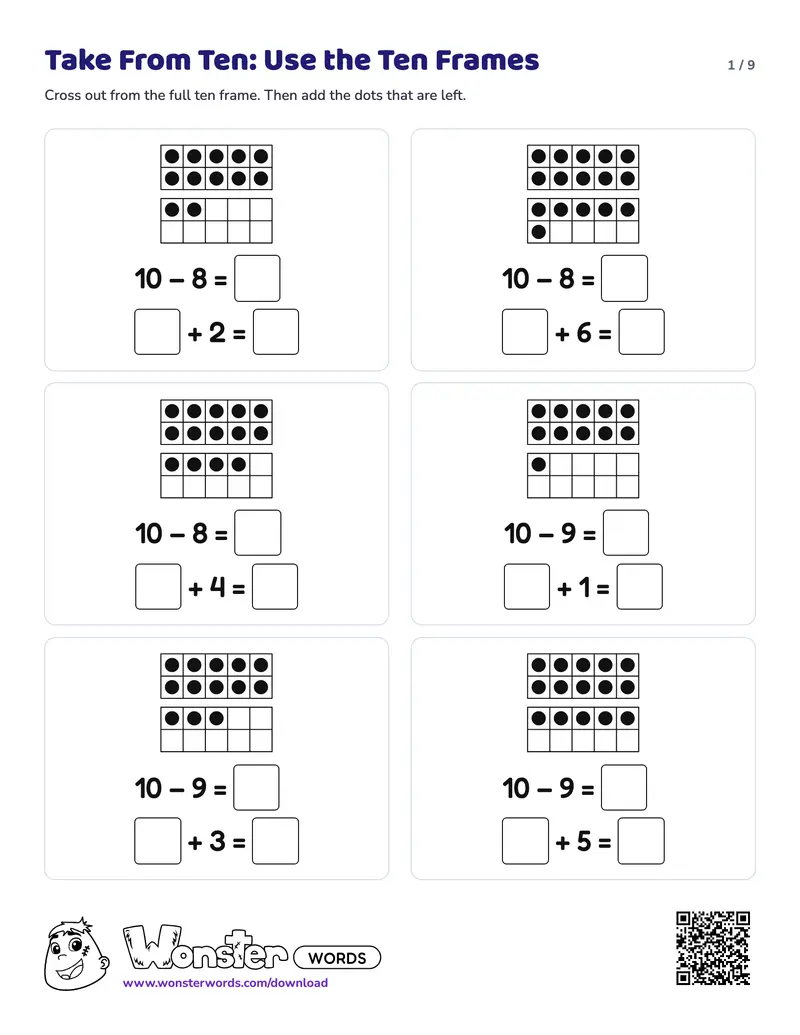
- Take From Ten, 9 pages, once making ten is easy. Crossing out from the full frame of a double ten frame, taking from ten in writing (13 − 9 as 10 − 9 = ☐, then ☐ + 3 = ☐), and mixed facts. The frame and writing pages take away 9 and 8, mixed on the page.
Each activity prints twice, with the same facts in a different mixed order each time, so no run of answers gives the next one away. Two answer key pages show every page in miniature, with each answer where your child writes it. A page for grown-ups at the end says what the sheet builds, why schools teach it this way, and how to use it. For second-grade review, print all four. Every sheet prints in black and white, with no account and no email.
For the groundwork, use the ten frame cards and double ten frame cards and the ways to make 10 sheet. Flash cards are in the addition and subtraction facts guide, and the addition chart shows every fact to 10 + 10. For mixed practice by range once the strategies are known (within 10, within 20, and mixed addition and subtraction), use the addition and subtraction worksheets.
Free PDF · no sign-up
Free printable doubles, near doubles, and make ten worksheets
Four free PDFs in black and white, with no account and no email, in teaching order: doubles facts, near doubles facts, make ten facts, and then take from ten. Each activity prints twice, each PDF has two answer key pages, and every PDF ends with a page of instructions for grown-ups on why, what for, and how to use it.
- Doubles Facts (PDF)76 facts · answer key included · 11 pages
Preview page 1Preview
- Near Doubles Facts (PDF)84 facts · answer key included · 11 pages
Preview page 1Preview
- Make Ten Facts (PDF)68 facts · answer key included · 11 pages
Preview page 1Preview
- Take From Ten (PDF)52 facts · answer key included · 9 pages
Preview page 1Preview
Frequently asked questions
What is the definition of doubles facts?
Doubles facts are the addition facts where both numbers are the same, such as 4 + 4 = 8 or 7 + 7 = 14. The ten doubles run from 1 + 1 = 2 to 10 + 10 = 20, and every answer is an even number. Doubles are among the first addition facts children know by heart, and they help with the facts next to them.
What does the term 'near doubles' mean?
Near doubles are addition facts whose two numbers are 1 or 2 apart, such as 6 + 7 or 6 + 8. A child solves one from the double beside it. For 6 + 7, 6 + 6 is 12, and 1 more is 13. For 6 + 8, the double in the middle, 7 + 7, gives the same total, 14.
Can you explain the make ten strategy in simple terms?
Making ten means filling one number up to 10 first, then adding what is left. For 8 + 5, the 8 needs 2 more to make 10, so take 2 from the 5. That leaves 3, and 10 + 3 is 13. It works for any addition fact that goes past 10.
What is a doubles plus one fact?
A doubles plus one fact is an addition fact whose two numbers are next to each other, such as 4 + 5 or 8 + 9. Its answer is the double of the smaller number and 1 more. For 8 + 9, 8 + 8 is 16, so 8 + 9 is 17.
What is a doubles fact for 7 + 6?
Two doubles help with 7 + 6. Start from 6 + 6 = 12 and add 1 to get 13, or start from 7 + 7 = 14 and take 1 away to get 13. Starting from the smaller double means your child only has to add.
How does the doubles plus one strategy differ from the doubles strategy?
The doubles strategy is knowing facts where both numbers are the same, such as 6 + 6 = 12. The doubles plus one strategy uses one of those known doubles to work out a fact one number away, such as 6 + 7 = 6 + 6 + 1 = 13. A child needs the doubles first, because doubles plus one starts from them.
Can the make ten strategy be used for subtraction as well?
Yes, in two ways that both go through 10. Back through ten solves 13 − 4 by taking 3 to reach 10, then 1 more, to leave 9. Take from ten splits 13 − 5 into 10 and 3 and takes the 5 from the 10, which leaves 5. Adding the 3 back gives 8.
Are near doubles commonly used in Common Core math standards?
The Common Core does not use the words near doubles, but it uses one as its own example. First-grade standard 1.OA.C.6 lists creating equivalent but easier or known sums, such as adding 6 + 7 as 6 + 6 + 1 = 12 + 1 = 13. That move is a near double.
What age should children start learning doubles facts?
Children begin to remember doubles in late kindergarten and first grade, at about age 5 or 6, and two hands already show 5 + 5. First graders learn all the doubles to 10 + 10 and use them for near doubles. By the end of second grade, children are expected to know all these addition facts from memory.
Is memorizing doubles facts more beneficial than understanding addition concepts?
Children need both, in that order. A child who understands why 6 + 7 is one more than 6 + 6 can work out a fact they have forgotten. A fact worked out the same way many times becomes a fact remembered. The standards ask for strategies in first grade and for facts from memory by the end of second grade.
In what types of math problems should the doubles plus one strategy be avoided?
Skip doubles plus one when the two numbers are more than 2 apart, such as 6 + 9 or 8 + 4. Starting from a double then needs a big extra step, and making ten is quicker, as in 9 + 1 + 5 = 15 for 6 + 9. When one number is 1, 2, or 3, counting on is quicker still.
Related guides
Last updated