
Math
Addition and Subtraction Facts to 20
What the addition and subtraction facts are and how many there are, how kids learn the subtraction facts through the addition facts, and free flash cards sorted by strategy with each answer on the back.
Grades: kindergarten to grade 2 · Common Core: 1.OA.C.6, 2.OA.B.2 · Texas: 2.4(A) · Related: Common Core 1.OA.B.3, 1.OA.B.4, K.OA.A.5; Texas 1.3(D)
The addition facts are the sums of two one-digit numbers, from 0 + 0 to 9 + 9, and each has subtraction partners: 8 + 5 = 13 gives 13 − 5 = 8 and 13 − 8 = 5. There are 100 addition facts, and 55 to learn once a turnaround pair such as 8 + 5 and 5 + 8 is counted once. They are the facts of kindergarten to second grade, and children learn the subtraction facts through the addition facts they come from.
Free addition and subtraction flash cards, sorted by strategy family with each answer on the back, are at the end of this guide. How a child gets from counting a fact to knowing it by heart is the subject of math facts and fact fluency.
What are the addition and subtraction facts?
The addition facts are the basic facts of two one-digit numbers, and the subtraction facts are the ones that go with them. The 100 addition facts run from 0 + 0 to 9 + 9, and each has subtraction partners: 8 + 5 = 13 gives 13 − 5 = 8 and 13 − 8 = 5. Counting a turnaround pair such as 8 + 5 and 5 + 8 once, there are 55 addition facts to learn. Teachers also call them basic facts or number combinations. They are the facts of kindergarten to second grade, and multiplication and division facts follow from third grade.
Children learn the facts in families, one strategy at a time. Our addition flash cards hold the 45 facts from 1 + 1 to 9 + 9, each turnaround pair once, in the families a child works them out with: count on 1, 2, or 3, doubles and near doubles, and make ten. The 81 subtraction facts that go with them, such as 13 − 5 and 13 − 8, come in three families too: count back or count up, doubles and near doubles, and take from ten. Each strategy is taught step by step in doubles, near doubles, and make ten.
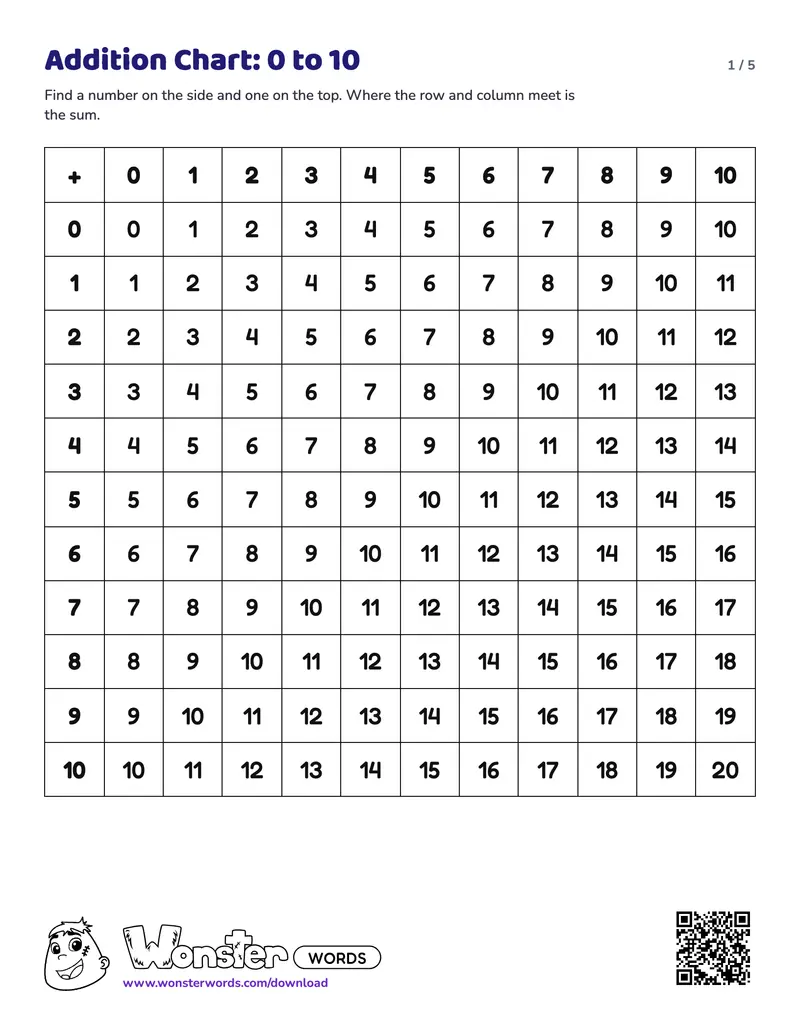
Under the Common Core, children are expected to know all the sums of two one-digit numbers from memory by the end of second grade (2.OA.B.2). What each grade before that expects is in when kids should know their addition and subtraction facts, and an addition chart holds every addition fact in one grid.
How do kids learn subtraction facts?
Subtraction facts are learned through the addition facts, not as a second list to memorize. The fact 13 − 5 asks “5 plus what makes 13?”, and first-grade standard 1.OA.B.4 frames it that way: “Understand subtraction as an unknown-addend problem.” Arthur Baroody writes in Teaching Children Mathematics (2006) that “5 − 3 can be thought of as 3 + ? = 5” (p. 29). A child who knows 8 + 5 = 13 already has 13 − 5 = 8 and 13 − 8 = 5, and a fact family shows all four facts at once.
Children use three ways in, depending on the fact:
- Count back, to take away 1, 2, or 3. For 9 − 2: eight, seven.
- Think addition, for most of the rest. For 12 − 8, think 8 + 4 = 12.
- Take from ten, for facts that cross ten. For 13 − 5, split 13 into 10 and 3, take the 5 from the 10 to leave 5, and add the 3 back: 8. The doubles and make ten guide teaches making ten for subtraction.
Subtraction feels harder than addition because counting back is harder than counting on. The Common Core progressions document calls counting down “less accurate and more difficult than counting on” (p. 37). The same document notes that subtraction “can frequently be solved by thinking of the related addition” (p. 18). Our subtraction guide sets out count back, count up, and think addition in full.
Practice subtraction facts beside the addition facts they come from. Add a family’s subtraction cards once its addition cards are quick. Our subtraction flash cards come in the same three families as the addition deck for that reason, and an addition chart can be read backwards for subtraction.
Are flash cards good for learning math facts?
Flash cards are good for learning math facts once a child can work the facts out. A flash card is retrieval practice: the child pulls the answer from memory, which turns a worked-out fact into a known one. The Association for Psychological Science’s summary of a 2025 review by McNeil, Jordan, Viegut, and Ansari lists “well-structured retrieval practice” among its recommendations. For a child anxious about timed work, the What Works Clearinghouse guide Assisting Students Struggling with Mathematics (2021) suggests “flashcards or other activities that do not present many problems at the onset”.
Four rules make a flash card session work:
- Only facts your child can already work out, one strategy family at a time. Our cards come one family to a page for this reason.
- A small pile. Mix one page of the new family with a few quick cards, never the whole deck.
- When a card is slow, say the strategy, not the answer. “It is a double and one more: 6 + 6 is 12, so…” Then slide the card back a few cards down.
- A few minutes on most days. A card joins the quick pile when your child answers it at once on two different days.
The subtraction deck follows the same rules, each card answered by thinking addition. Three habits undo them: all 45 cards every night, racing the slow cards, and cards before the strategy. Working a fact out comes before knowing it, as strategies first, then memory explains. For a kindergartner, cards that show an amount come before cards that show a fact, such as ten frame cards and subitizing dot cards.
Print our flash cards double-sided, flipping on the long edge, and each answer lands on the back of its card. Cut along the lines, and your child says the answer and turns the card over to check. A few minutes a day with them is the routine in how to practice math facts at home.
Free addition and subtraction flash cards
Our free math facts flash cards come as two PDFs, addition and subtraction, each sorted by strategy family.
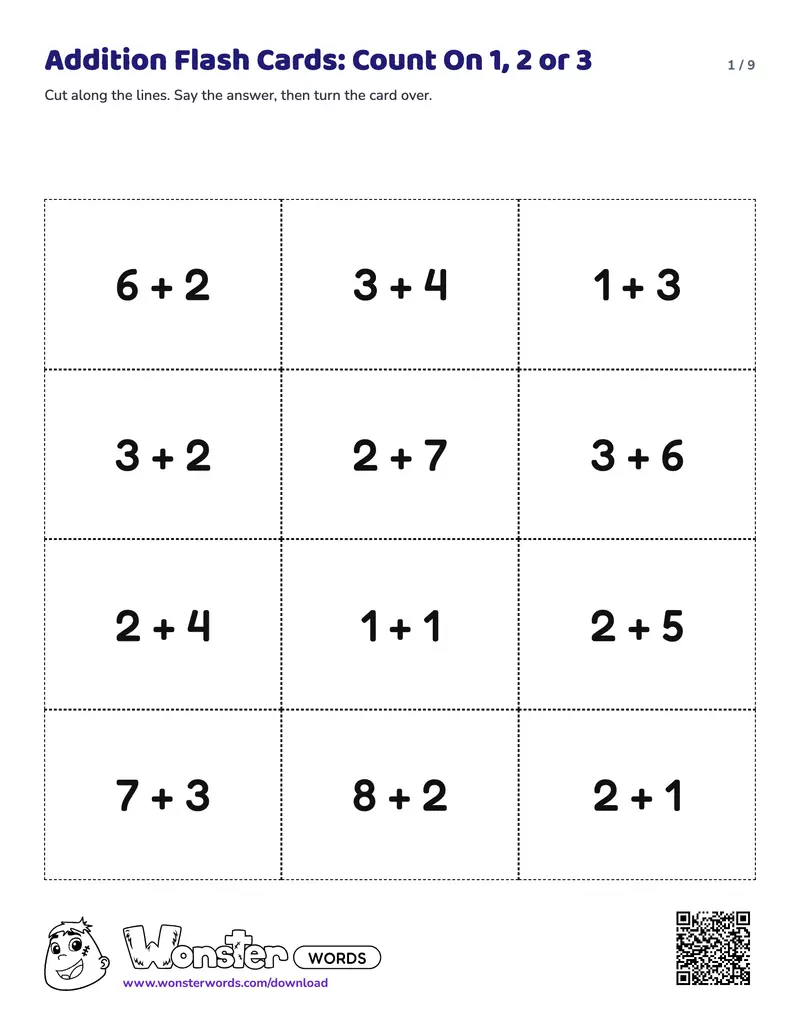
- Addition Flash Cards, 9 pages, late kindergarten to second grade. The 45 facts from 1 + 1 to 9 + 9, each turnaround pair once, twelve cards to a page: count on 1, 2, or 3 (two pages), doubles and near doubles, and make ten.
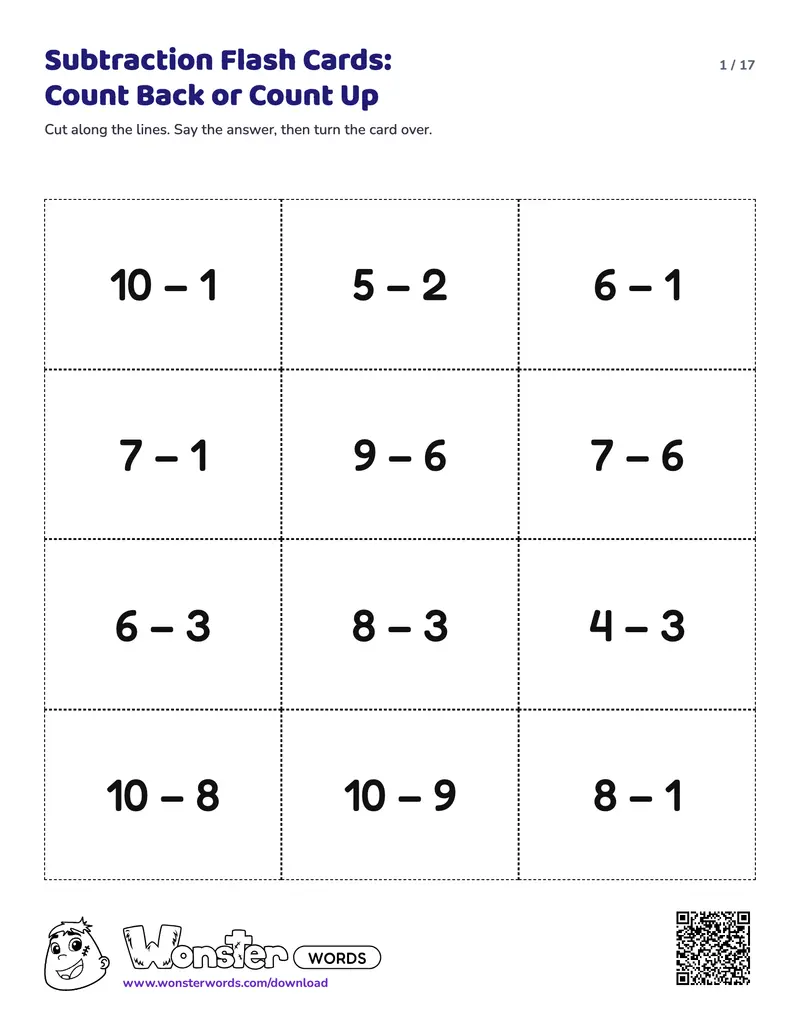
- Subtraction Flash Cards, 17 pages, first and second grade. The 81 subtraction facts that go with the addition deck, such as 13 − 5 and 13 − 8: count back or count up (four pages), doubles and near doubles (two), and take from ten (two).
Print both flash card decks double-sided, and flip on the long edge. Every card page is followed by its answer page. A long-edge flip, the usual double-sided setting for a portrait page, puts each answer on the back of its card. Printed one-sided, the answer pages work as a key, with each row read from the right.
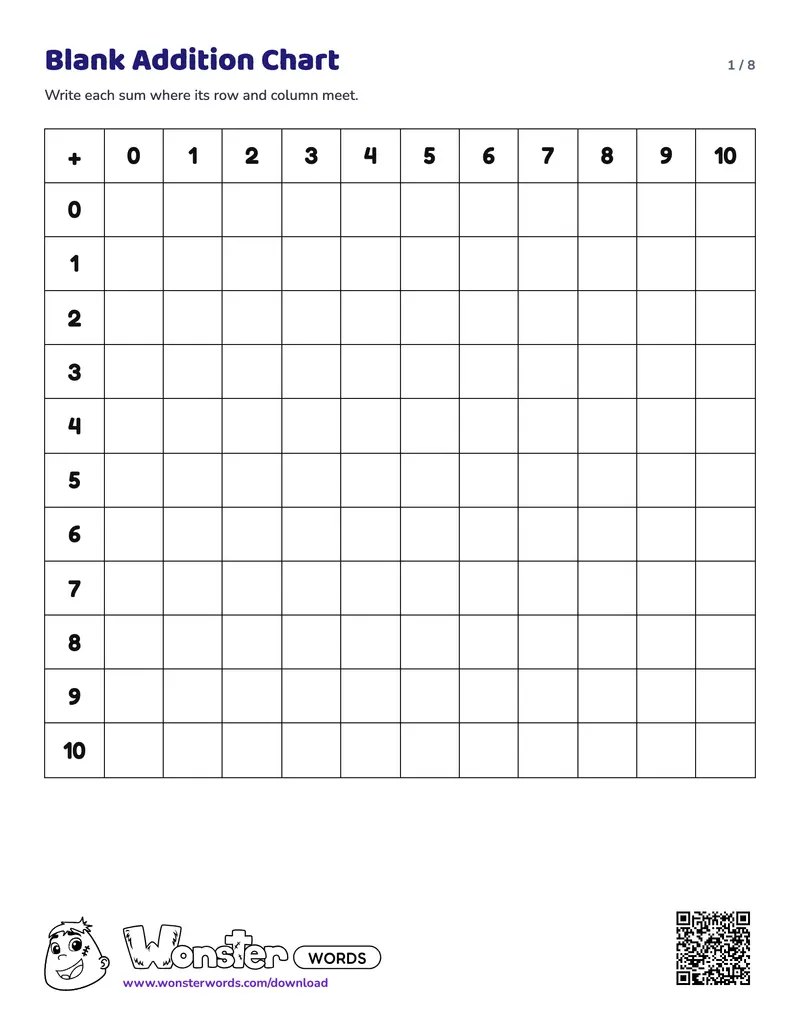
Every PDF ends with a page for grown-ups on how to use it. Below the two decks are the addition chart and blank addition chart from our addition chart page, and the Take From Ten sheet and the within-20 worksheets from our other math pages, for written practice of the same facts.
Free PDF · no sign-up
Free printable addition and subtraction flash cards
Two free PDFs in black and white, with no account and no email: addition and subtraction flash cards. Print them double-sided, flipping on the long edge, so each answer lands on the back of its card. Every PDF ends with a page of instructions for grown-ups on why, what for, and how to use it. Below them are five sheets from our other math pages: the addition chart, the blank addition chart, Take From Ten, and the within-20 addition and subtraction worksheets.
- Addition Flash Cards (PDF)45 cards · answer key included · 9 pages
Preview page 1Preview
- Subtraction Flash Cards (PDF)81 cards · answer key included · 17 pages
Preview page 1Preview
- Addition Chart (PDF)477 facts · 5 pages
Preview page 1Preview
- Blank Addition Chart (PDF)227 facts · answer key included · 8 pages
Preview page 1Preview
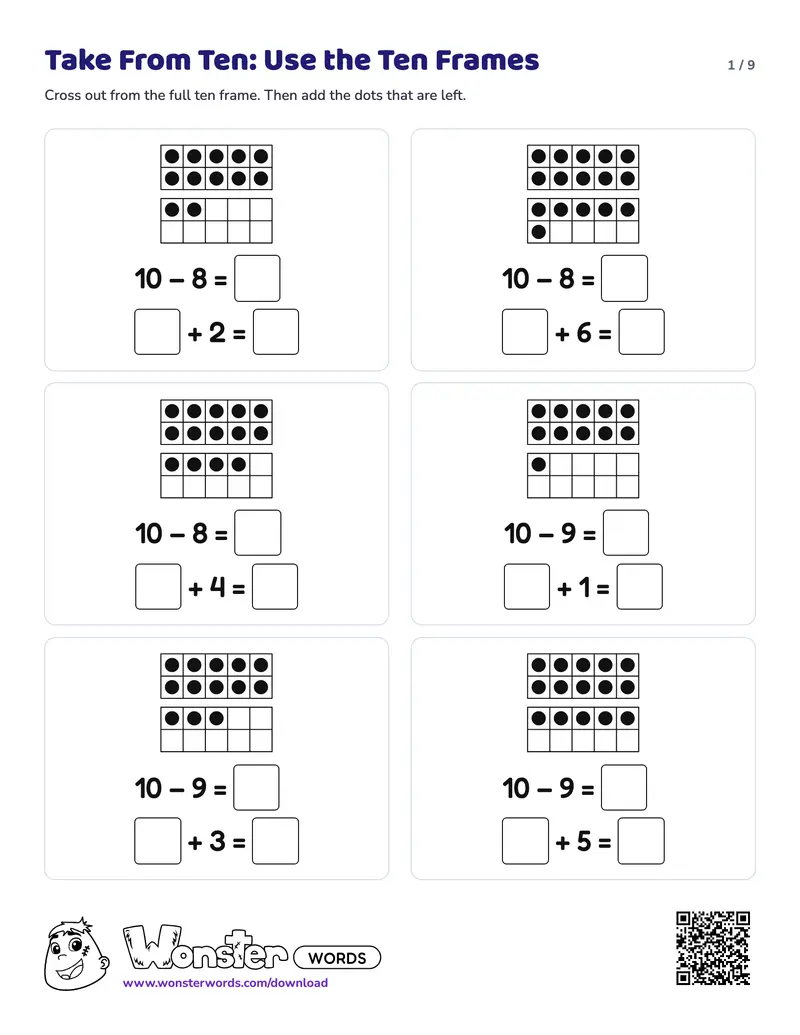
- Take From Ten (PDF)52 facts · answer key included · 9 pages
Preview page 1Preview
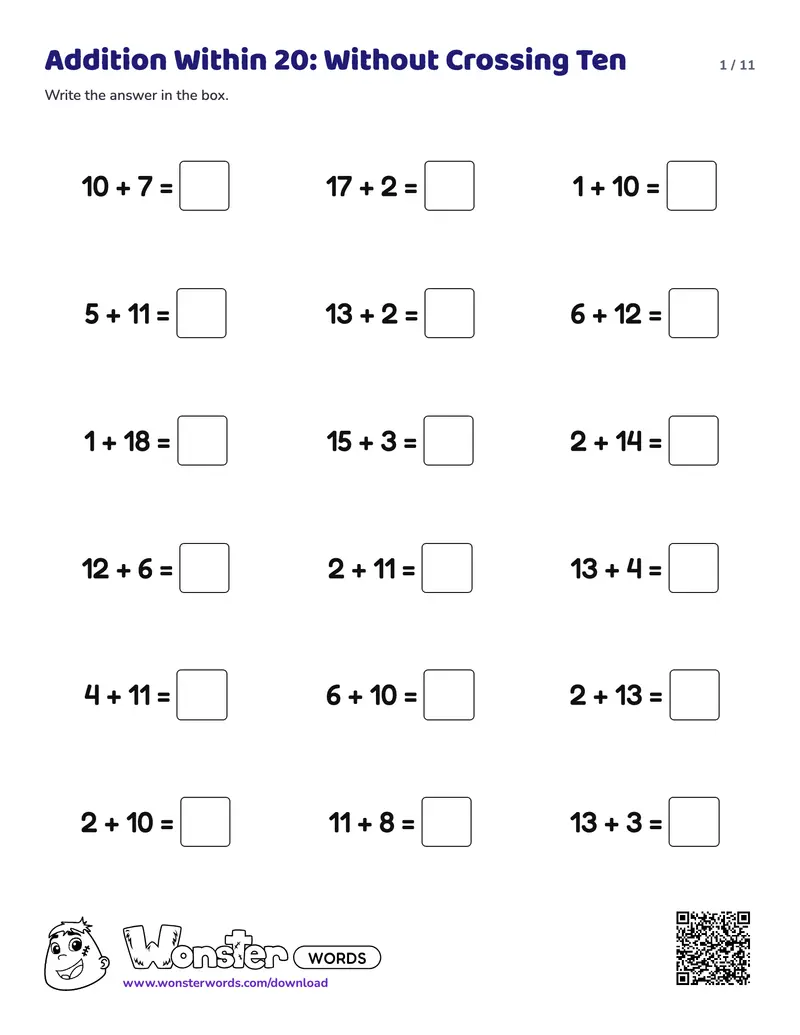
- Addition Within 20 (PDF)144 problems · answer key included · 11 pages
Preview page 1Preview
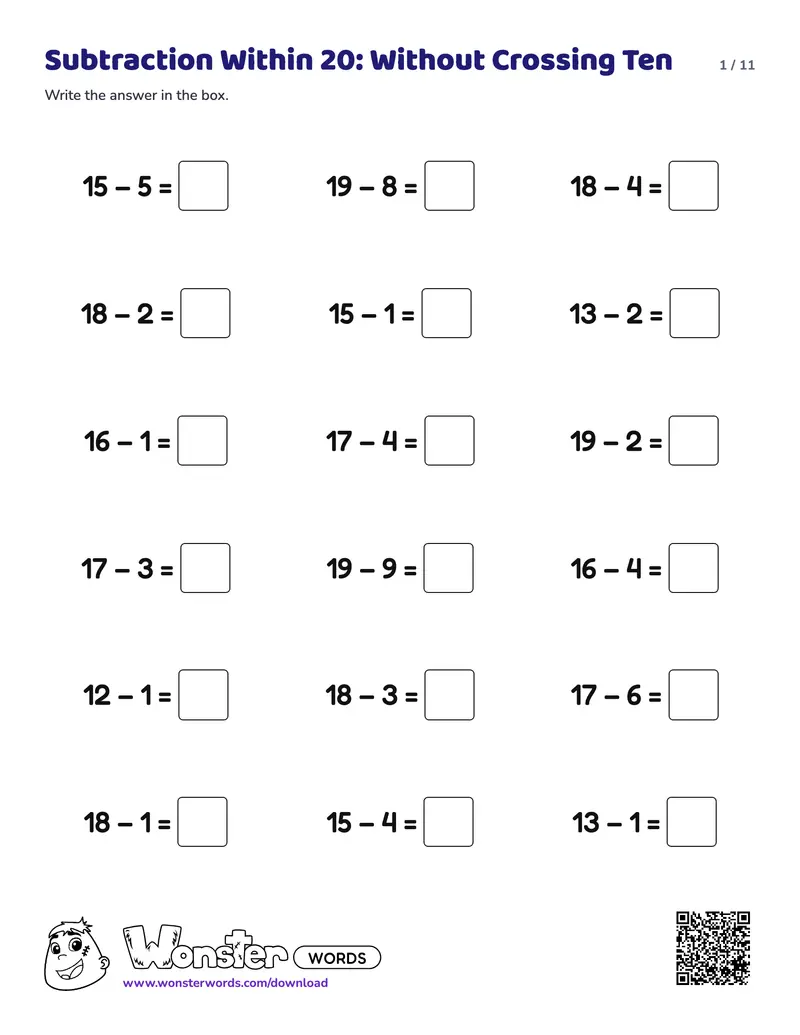
- Subtraction Within 20 (PDF)144 problems · answer key included · 11 pages
Preview page 1Preview
Frequently asked questions
Are flash cards effective for mastering addition facts?
Yes, for facts a child can already work out. Flash cards are retrieval practice, which turns a worked-out fact into a known one. Use a small pile from one strategy family for a few minutes on most days, and when a card is slow, say the strategy rather than the answer. Cards used before the strategy leave a child only guessing or counting.
What age is best to start using addition facts flash cards?
Late kindergarten to second grade, once a child can work out the facts on the cards. For a kindergartner, cards that show an amount, such as ten frame cards and subitizing dot cards, come before cards that show a fact. Subtraction flash cards fit first and second grade, once the addition facts they go with are quick.
What age should children start learning subtraction facts?
Children start subtraction facts in kindergarten, at about 5, alongside addition, and are expected to be fluent within 5 by the end of that year. First graders learn subtraction within 20 as a missing part, so 13 − 5 is 5 plus what makes 13. Practice each subtraction fact once the addition fact that goes with it is quick.
How to use flash cards for subtraction facts practice?
Add a family's subtraction cards once its addition cards are quick, and have your child answer each card by thinking addition, so 13 − 5 asks what goes with 5 to make 13. Keep to a small pile for a few minutes on most days. When a card is slow, say the strategy rather than the answer, and slide the card back a few cards down.
Related guides
Last updated